

When most of us hear “technology” in a parenting context, our minds jump straight to screens — phones, tablets, games consoles. But technology is a much bigger category than the device your child is currently glued to. It’s the washing machine that gives you back an evening. It’s the baby monitor that lets you actually sleep. It’s the smart thermostat, the online banking app, the car’s safety sensors, the video call that lets a grandparent read a bedtime story from another country. Technology is any tool that extends what we can do — and as fathers, we’re navigating more of it, faster, than any generation before us.
This section isn’t about fear, and it isn’t about blind enthusiasm either. It’s about understanding technology well enough to use it deliberately — for our families, our households, and ourselves.
A brief history: how we got here
It’s worth remembering how recent all of this is.
1970s–80s — The home computer arrives. Families that had one mostly used it for basic tasks and early games; it was a novelty, not a necessity.
1990s — The internet moves into homes. Dial-up connections, the first family email addresses, the beginning of “screen time” as a phrase parents started using.
2000s — Broadband, then smartphones. The BlackBerry and early iPhone changed work-life boundaries permanently — suddenly, work could follow you home.
2010s — The smartphone becomes universal, and social media becomes a daily habit for both adults and, increasingly, teenagers. Tablets enter classrooms and living rooms.
2020s — Smart homes, wearables, and artificial intelligence move from novelty to normal. AI tools now help with homework, work tasks, and even parenting research (you might be reading AI-assisted content right now).
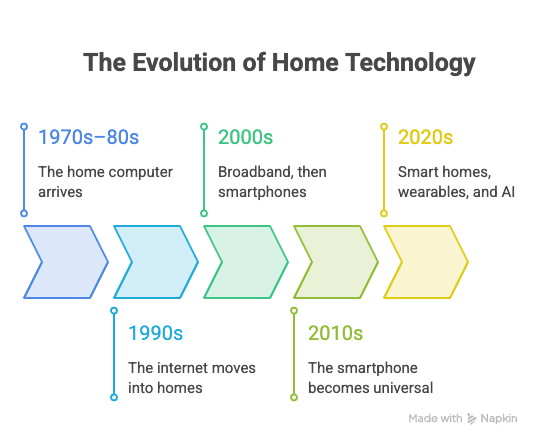
Each generation of fathers has faced a version of this same question: how much do we let this new thing into our family’s life? What’s changed is the pace — technology now evolves within a single childhood, not across generations.
What counts as “technology” for a family
It’s worth widening the lens beyond screens:
- Communication tools — video calls, messaging apps, family group chats
- Household tech — smart speakers, robot vacuums, connected thermostats, video doorbells
- Safety and monitoring — baby monitors, GPS trackers for older kids, home security systems
- Health and wellbeing — fitness trackers, sleep monitors, telehealth appointments
- Learning tools — educational apps, online tutoring, coding platforms for kids
- Entertainment — streaming, gaming, social media
- Work-enabling tech — remote work tools that shape how much time you actually have at home
Seen this way, technology isn’t one thing to manage — it’s dozens of tools, each with its own trade-offs.
The genuine benefits
It’s easy to focus on the negatives, so let’s start with what technology has actually given families:
Connection across distance. A father working away, or a grandparent overseas, can still be part of daily life through a video call. That’s not a small thing — it’s a genuine gift previous generations didn’t have.
Time back. Household tech — from dishwashers to smart shopping lists — hands back hours that used to be spent on repetitive tasks. Those hours can go straight into time with your kids.
Access to knowledge. Whatever question you have as a father — from sleep training to teenage mental health — there’s more good information available now, more quickly, than at any point in history.
Safety tools. GPS trackers, video doorbells, and monitoring apps give parents real peace of mind, particularly as children start becoming more independent.
Preparation for the world they’ll grow up in. Like it or not, digital literacy is now a life skill. Children who understand technology — how it works, not just how to consume it — are better equipped for their future, whatever that future holds.
The genuine negatives
None of this means technology is without cost:
Attention and focus. Devices are designed to be engaging — sometimes deliberately addictive — and that applies to adults as much as children. It’s easy to be physically present but mentally elsewhere.
Sleep disruption. Screens before bed, for both kids and adults, are well documented to affect sleep quality.
Social comparison. Social media, in particular, can distort a child’s — or a parent’s — sense of what “normal” looks like.
Reduced boundaries between work and home. The same technology that lets you work remotely can also mean work never really switches off.
Skill trade-offs. Some skills fade as technology takes over — navigation, mental arithmetic, even patience — while new ones (digital literacy, critical evaluation of information) become essential.
None of these are reasons to reject technology. They’re reasons to use it with intention.
Our approach: embrace it, with moderation
Technology isn’t going anywhere, and pretending otherwise doesn’t serve our children well. The fathers who navigate this best aren’t the ones who ban every device — they’re the ones who stay engaged enough to understand what their kids are using, model healthy habits themselves, and make deliberate choices rather than default ones.
That might mean:
- Setting boundaries around when devices are used (mealtimes, bedtimes) rather than banning them outright
- Being honest about your own screen habits — kids notice what we do more than what we say
- Staying curious about the tools your children use, rather than dismissing them
- Choosing technology that adds genuine value to family life, not just what’s easiest to hand over
- Talking openly with your kids about both the benefits and risks, so they build their own judgement over time
Technology is a tool. Like any tool, it can build something valuable or cause real harm — the difference is almost always in how it’s used, not whether it exists. As fathers, our role isn’t to gatekeep technology out of our children’s lives. It’s to help them — and ourselves — use it well.
More articles in this section are coming soon — covering specific tools, age-appropriate guidance, and honest reviews from fathers who’ve tried them.