
New to all this? Start here.
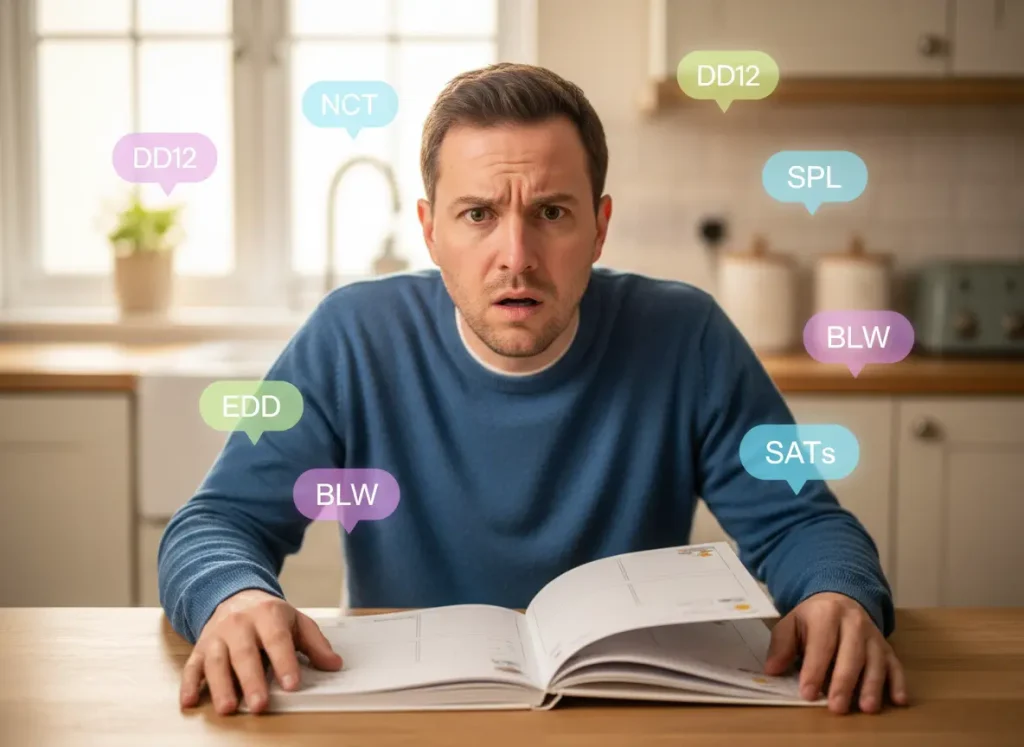
If you’re reading this before the baby’s even arrived, you might not recognise half of these terms yet — and that’s exactly the point. Parenting jargon isn’t going anywhere. It exists because it’s quicker to say “SPL” than “Shared Parental Leave,” and quicker to type “DD12” than “my 12-year-old daughter.” Once a term catches on, it sticks — so there’s no getting round it, only getting on board with it.
How to use this page: don’t try to memorise all 100 in one sitting. Read through the list once now, then come back and skim it again every few weeks as you hit each new stage. Repetition is what makes it stick — the terms that feel meaningless today will be second nature by the time you actually need them, whether that’s in the delivery room or in a WhatsApp group full of shorthand you’re expected to just know.
Bookmark this page now, so it’s there when you need it.
Pregnancy & Birth
NCT — National Childbirth Trust. Runs antenatal classes and builds a local parent network, often the first place you’ll meet other expecting couples. “We signed up for NCT classes so we’d meet other local parents before the baby arrives.”
EDD — Estimated due date, calculated from the last period, not a guarantee. “Her EDD is the 14th, but only 1 in 20 babies actually arrive on the due date.”
Trimester — One of three roughly 13-week stages of pregnancy. “We’re heading into the third trimester, so the hospital bag needs packing soon.”
Braxton Hicks — Practice contractions that tighten the uterus but aren’t real labour. “Don’t panic if she gets some tightening in the evenings — that’s probably just Braxton Hicks.”
Show — The mucus plug coming away, sometimes a sign labour is approaching. “She had a show this morning, so we’re on standby.”
Waters breaking — The amniotic sac rupturing, releasing fluid. “Her waters broke at 2am, so we headed straight to the hospital.”
Gas and air — Entonox, an inhaled pain relief used during labour. “She used gas and air through most of the early contractions.”
Epidural — A spinal injection that numbs pain during labour. “After 12 hours she opted for an epidural to get some rest.”
TENS machine — A device delivering small electrical pulses to ease early labour pain. “We hired a TENS machine to help her manage contractions at home.”
Birth plan — A written note of preferences for labour and delivery, shared with midwives. “Our birth plan says she wants to try a water birth if possible.”
Induction — Medically starting labour rather than waiting for it naturally. “They booked her in for an induction at 41 weeks.”
C-section — Caesarean section, a surgical delivery through the abdomen. “It ended up being an emergency C-section, but both were fine.”
VBAC — Vaginal birth after a previous caesarean. “She’s hoping for a VBAC this time round, if the midwife team supports it.”
Meconium — A newborn’s first stool, dark and tar-like. “Don’t be alarmed by the first nappy — that’s just meconium.”
Colostrum — The nutrient-dense first milk produced after birth, before regular milk comes in. “Even a few drops of colostrum in the first day makes a difference.”
Skin-to-skin — Holding a newborn directly against bare skin, usually right after birth. “I did an hour of skin-to-skin while she was being stitched up — it’s a good bonding moment for dads too.”
Apgar score — A quick 0–10 health check given to newborns at one and five minutes old. “He scored a 9 on his Apgar, which the midwife said was great.”
Doula — A trained, non-medical companion providing labour and birth support. “We hired a doula to support my wife through labour alongside me.”
Red book — The NHS Personal Child Health Record, tracking growth, jabs, and milestones. “Bring the red book to every health visitor appointment.”
Perineum / episiotomy — The area between vagina and anus; an episiotomy is a surgical cut sometimes made there during delivery. “She had a small episiotomy to help with delivery — it’s more common than people talk about.”
Early Years (0–5)
Health visitor — An NHS professional who supports child development from birth to age five. “Our health visitor comes round for the 6-week and 1-year checks.”
2-year check — A routine developmental review carried out around age two. “She’s booked in for her 2-year check next Tuesday.”
Weaning — Introducing solid food, typically from around six months. “We started weaning with simple purées before moving to finger foods.”
BLW — Baby-led weaning, where the baby self-feeds whole pieces of food rather than being spoon-fed purée. “We went the BLW route — messier, but she got the hang of feeding herself quickly.”
Tummy time — Supervised time on the stomach to build neck and core strength. “A few minutes of tummy time after each nap helps build strength for crawling.”
Sleep regression — A temporary phase of worse sleep, usually tied to a developmental leap. “The 4-month sleep regression hit us hard — feels brutal but it does pass.”
Milestones — Expected developmental stages, like rolling, crawling, or first words. “Every baby hits milestones at a different pace, so try not to compare too much.”
SIDS — Sudden infant death syndrome; safe sleep practices reduce the risk. “We follow the back-to-sleep guidance to reduce the risk of SIDS.”
Sure Start — UK government-funded centres offering early years family support. “Our local Sure Start centre runs free baby groups on Tuesdays.”
Reflux — A baby bringing up milk after feeding, common and usually harmless. “He’s got reflux, so we keep him upright for 20 minutes after each feed.”
Colic — Excessive, unexplained crying in an otherwise healthy young baby. “The colic phase was rough, but it settled by around 12 weeks.”
Dummy / pacifier — A soother used to comfort a baby. “We only use the dummy for sleep, not throughout the day.”
Growth spurt — A period of rapid growth, often accompanied by more feeding and waking. “She’s feeding constantly this week — probably a growth spurt.”
Object permanence — The understanding that things still exist even when out of sight. “Peekaboo is funny to babies because object permanence hasn’t developed yet.”
Separation anxiety — Distress a child feels when separated from a parent or main carer. “Nursery drop-offs are tough right now because of separation anxiety.”
Tantrums — Emotional outbursts, common and developmentally normal in toddlers. “He had a full tantrum in the supermarket over the wrong colour cup.”
Terrible twos — Informal term for the defiant, tantrum-prone phase around age two. “We’re deep in the terrible twos — everything is ‘no’ at the moment.”
Comforter — An attachment object, like a blanket or soft toy, that provides security. “She won’t sleep without her comforter, so we bought a spare in case it’s lost.”
Potty training — Teaching a child to use the toilet instead of nappies. “We’re starting potty training over a long weekend so we can focus on it.”
Nursery key worker — The staff member specifically assigned to oversee your child at nursery. “Her key worker gives us a quick update every day at pickup.”
Family Life & Online Shorthand
DH/DW/DP — Dear husband/wife/partner, common shorthand on parenting forums. “My DH is on nursery pickup duty this week.”
OH — Other half. “My OH thinks we should wait another year before moving her rooms.”
DD/DS — Dear daughter/son, usually followed by an age, e.g. DD12. “DD12 has been glued to her phone since half term.”
LO — Little one. “LO finally slept through the night!”
TTC — Trying to conceive. “We were TTC for over a year before it happened.”
SAHD — Stay-at-home dad. “He became a SAHD after his wife’s job offered better career progression.”
WFH dad — A father who works from home. “Being a WFH dad means I can do the school run most days.”
NAK — Nursing/typing at keyboard — an informal excuse for typos, from one-handed typing. “Sorry for the typos, NAK.”
PND — Postnatal depression. “It’s worth knowing dads can experience PND too, not just mums.”
Blended family — A family formed from previously separate households, often through remarriage. “We’re a blended family now, with kids from both previous relationships.”
Co-parenting — Both parents actively involved in raising a child after separation. “We’ve kept a solid co-parenting routine since splitting up.”
Contact centre — A neutral venue for supervised contact between a child and parent, post-separation. “Contact started at a contact centre before moving to unsupervised visits.”
Family court — The court dealing with disputes over child arrangements and custody. “It ended up going to family court to agree the arrangements.”
Child arrangements order — A legal order setting out where a child lives and who they spend time with. “The child arrangements order sets out alternate weekends with each parent.”
PA (parental alienation) — A term used when a child is manipulated into rejecting a parent. “Parental alienation is a serious and contested issue that family courts take carefully.”
CAFCASS — The body that advises family courts on children’s welfare in England and Wales. “A CAFCASS officer spoke to the kids as part of the court process.”
Mum guilt / Dad guilt — A common feeling of inadequacy around parenting choices. “Missing the school play for work triggered a proper bout of dad guilt.”
Gentle parenting — A parenting style prioritising empathy and connection over punishment. “We’ve tried to lean into gentle parenting, though it’s not always easy in the moment.”
Screen time — Time spent using devices, often a source of debate between parents. “We cap screen time at an hour on school nights.”
Village (as in “it takes a village”) — The support network of family and friends that helps raise a child. “Grandparents doing pickup twice a week is genuinely our village.”
Education (Including Teens)
EYFS — Early Years Foundation Stage, the curriculum framework for under-5s. “Nursery and reception both follow the EYFS curriculum.”
Key Stage 1–4 — Groupings of school years by curriculum stage. “She’s just moved into Key Stage 2, which covers Years 3 to 6.”
SATs — National curriculum tests taken in Year 2 and Year 6. “He’s been doing SATs practice papers at school this term.”
Ofsted — The body that inspects and rates schools in England. “The school’s last Ofsted rating was ‘Good’.”
SEN/SEND — Special Educational Needs (and Disabilities). “The school has a dedicated SEN/SEND coordinator we can speak to.”
EHCP — Education, Health and Care Plan, a formal legal document outlining SEND support. “We’re going through the process of applying for an EHCP for extra classroom support.”
IEP — Individual Education Plan, an informal support document used within school. “His teacher set up an IEP to track his reading targets.”
PTA — Parent Teacher Association, running fundraising and school events. “The PTA is organising the summer fair this year.”
INSET day — A teacher training day when pupils don’t attend school. “We need to sort childcare for the INSET day next Friday.”
Catchment area — The geographic zone that determines admission priority for a school. “Our catchment area covers two primary schools, so we applied for both.”
Oversubscribed — When a school has more applicants than places available. “That school is heavily oversubscribed, so it’s worth having a backup choice.”
Pastoral care — School support focused on pupil wellbeing rather than academics. “The pastoral care team stepped in when she was struggling with anxiety.”
Safeguarding lead — The staff member responsible for child protection matters. “Any welfare concerns go through the safeguarding lead first.”
GCSEs — Exams typically taken at age 16, marking the end of compulsory secondary education. “She starts her GCSE options next year, so we’re talking through subject choices.”
Mocks — Practice or trial exams sat before the real ones. “His mocks are in January, ahead of the real GCSEs in the summer.”
A-levels — Post-16 qualifications typically required for university entry. “She’s chosen three A-levels to study in sixth form.”
UCAS — The centralised UK university applications service. “UCAS applications for next year open in September.”
Predicted grades — A teacher’s estimate of likely exam results, used in university applications. “His predicted grades will go on the UCAS form before he’s even sat the exams.”
Sixth form — Years 12–13, the post-GCSE stage of secondary education. “She’s staying on at the same school for sixth form.”
Apprenticeship / T-level — Vocational alternatives to traditional A-levels. “He’s leaning towards an apprenticeship instead of sixth form.”
Money & Parental Rights
SMP — Statutory Maternity Pay, the minimum paid maternity leave entitlement. “She’s on SMP for the next few months — 90% of pay for six weeks, then a flat rate.”
SPP — Statutory Paternity Pay, paid leave for fathers/partners around the birth. “I’m taking two weeks of SPP once the baby arrives.”
SPL — Shared Parental Leave, allowing parents to split leave between them. “We’re using SPL so I can take a chunk of leave later in the year.”
ShPP — Statutory Shared Parental Pay, the pay associated with SPL. “ShPP is paid at the same flat statutory rate as the later weeks of SMP.”
Maternity/Paternity leave — Time off work granted around the birth or adoption of a child. “Check your contract — some employers offer enhanced maternity/paternity leave above the statutory minimum.”
Tax-Free Childcare — A government scheme topping up childcare savings, up to £2,000 a year per child. “We use Tax-Free Childcare to help cover nursery fees.”
15/30 funded hours — Free childcare hours for eligible 3–4 (and some 2) year-olds in England. “Once she turns three, we’re entitled to the funded hours scheme.”
Child Benefit — A monthly payment for those responsible for a child. “We claim Child Benefit even though one of us earns over the threshold, since it protects her National Insurance record.”
HICBC — High Income Child Benefit Charge, which claws back Child Benefit above a set earnings threshold.“Because of the HICBC, we ended up repaying some of our Child Benefit through Self Assessment.”
Universal Credit — A means-tested benefit that can include support with childcare costs. “Universal Credit can cover up to 85% of eligible childcare costs for lower-income households.”
Sure Start Maternity Grant — A one-off £500 payment for qualifying low-income families having their first child.“We weren’t eligible for the Sure Start Maternity Grant since it’s usually only for a first child.”
Statutory Sick Pay (SSP) — The legal minimum sick pay from an employer. “He was off with the baby’s illness, but SSP only covers his own sickness, not caring for a sick child.”
KIT days — Keeping In Touch days, allowing limited work during leave without losing statutory pay. “She used a couple of KIT days to sit in on the team’s planning meeting.”
Flexible working request — A legal right to formally request changed hours or location. “I put in a flexible working request to do two days from home after paternity leave ended.”
Childcare voucher scheme — An older salary-sacrifice childcare scheme, now closed to new joiners. “We’re still on the old childcare voucher scheme from before it closed to new applicants.”
Workplace nursery scheme — An employer-provided childcare benefit, often tax-efficient. “My company runs a workplace nursery scheme that saves us a fair bit each month.”
Free school meals — Means-tested free meals provided in state education. “Eligibility for free school meals also affects things like pupil premium funding.”
Pupil premium — Additional school funding allocated for disadvantaged pupils. “Schools use pupil premium funding for extra tutoring and support.”
Guardian’s Allowance — A payment for those raising a child who isn’t their own, typically after the parents have died. “Guardian’s Allowance can be claimed alongside Child Benefit in qualifying cases.”
Parental bereavement leave — Statutory leave granted following the death of a child under 18. “Parental bereavement leave gives eligible parents two weeks off, which can be taken flexibly within a year.”
New here? Bookmark this and come back.
Whatever stage you’re at, you’ll hit terms on this list you don’t need yet — and that’s fine. Save the page, and revisit it every few weeks as your child grows into the next stage. The jargon isn’t going away, but the more familiar it gets, the less overwhelming it feels.
👉 Bookmark this page now, and share it with another dad who could use it.

Discover more from Dad Diary
Subscribe to get the latest posts sent to your email.
